
The Second Wound
On overpainting, and what lives between the lens and the hand

The photograph is already a kind of violence. Light enters, the shutter fires, a moment is pinned — excised from time and held under glass. It cannot breathe. It cannot lie. That is its power. That is also its limit.
When I print an image at 1500 millimetres (59 inches) and set it on the studio floor, something changes. Scale does something to truth. What was a photograph becomes a surface. A terrain. And the question arrives, quietly but insistently: what happens if I touch it?
Not retouch. Not correct. Touch. With paint. With a brush or a stick or the thrown wrist. With the whole history of gesture that painting carries inside it, against the frozen fact of what the camera recorded.
This is what overpainting is, at its most essential: an argument between two ways of knowing. The photograph knows by capturing. Paint knows by moving. One freezes time; the other inscribes it. They should not coexist on the same surface. And yet — when they do — something emerges that neither could produce alone.
The photograph is evidence. The paint is testimony. They are not the same thing.
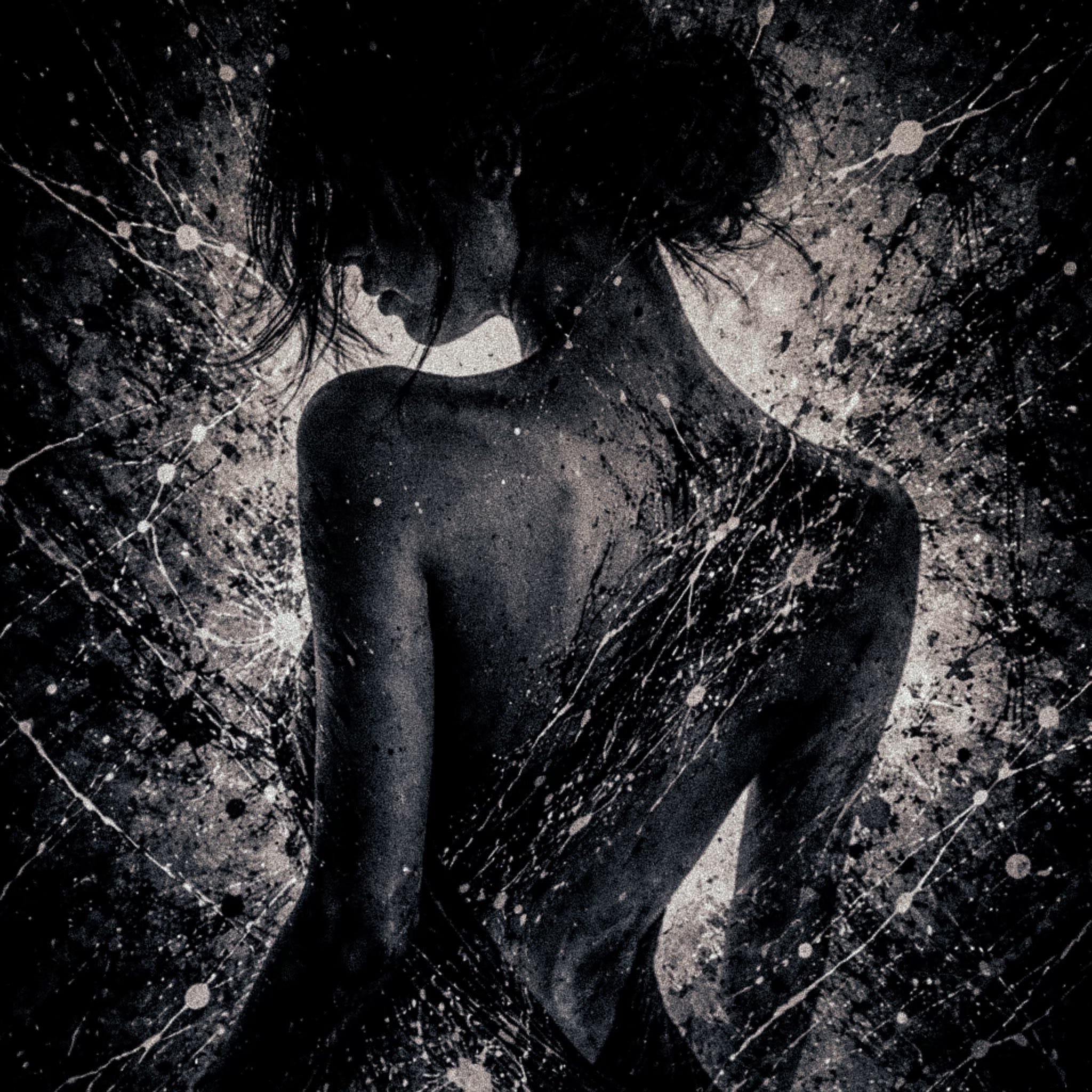
Take this image: a figure, back turned, head inclined. Shot wide open, that characteristic softness at the shoulder, the skin rendered in values of grey so precise they feel almost tactile. The photograph holds her perfectly. Too perfectly, perhaps. It holds her the way a specimen is held — complete, resolved, finished.
Then the paint arrives. In this case, gestural — flung and splattered, arcing across the surface like a system of veins or trajectories or the visible record of some internal weather. Suddenly the image has a before and an after. The paint is not decorating the photograph. It is interrupting it. And in that interruption, a third thing appears: the space between what was seen and what was felt.
What does overpainting take away? Certainty. The photograph’s claim to have captured reality intact. The flatness. The finality. You look at an unpainted photograph and you know where it ends. You look at an overpainted one and you are no longer sure. The edges bleed into intention. The surface becomes archaeological — layer over layer, each one with its own logic, its own time signature.
What does it give? The body of the image, in the most literal sense. A photograph printed on Baryta paper and mounted to aluminium is already more than a print — it has weight, presence, a physical fact in the room. But paint adds another layer of materiality, one that is indexical in the opposite way to photography. The photograph indexes the light that bounced off the world. The paint indexes the motion of the hand — its speed, its hesitation, the height from which the wrist released. Both are records. Neither is the thing itself.
Two kinds of trace on a single surface. Both honest. Neither complete.
I think of Richter, who spent decades oscillating between the photographic and the painterly — sometimes blurring photographs until they resembled paintings, sometimes painting from photographs until they became something else entirely. What he understood, and what I keep returning to, is that the tension itself is the subject. Not the figure. Not the gesture. The space where they collide.
The gestural mark — whether Pollock’s drip, Richter’s squeegee, or paint thrown from the wrist — does not interpret the photograph. It refuses interpretation. It says: here is something the camera could not record. Not light, but energy. Not form, but force. It introduces chance into a medium that has none. Photography is deterministic; the camera renders what was there. Paint, flung or dragged, carries within it the irreducible accident of a living body in motion.
This is why large format matters. At 1500 millimetres, you cannot stand back and contemplate. You are inside the work. The photograph is no longer an image; it is an environment. And in that environment, the paint is not decoration — it is weather. You feel it differently. The scale forces the body into the equation in a way that a smaller print never can.
The question I return to is not stylistic. It is not: what kind of marks shall I make? It is: what does this image still need to say that it could not say alone? Sometimes the answer is restraint — a single thin glaze, colour bleeding through form. Sometimes it is violence — the surface torn up, almost destroyed, the photograph visible only in fragments beneath. Both are in service of the same thing: releasing what the camera held too tightly.
There is a moment in every overpainted work when the photograph dies a little. When paint covers a detail that took real skill to capture. When a mark obscures a piece of skin, an eye, the precise quality of shadow at the collarbone. That moment is the work’s threshold. You have to be willing to destroy part of what you made in order to make something new. It is, in this sense, an act of faith — or perhaps of recklessness. The two are often the same.
What emerges, when it works, is not photography with paint on top. It is not painting that uses photography as its base. It is a third thing — something that carries the memory of both disciplines without belonging entirely to either. A duality that does not resolve. A conversation that refuses to end.
The photograph knows what it saw. The paint knows what it felt. The work holds both accountable.
I have come to believe that this duality is not a problem to be solved. It is the condition of any work that takes the world seriously. We are always between two ways of knowing — the precise and the intuitive, the fixed and the flowing, the recorded and the remembered. Overpainting simply makes that condition visible. It puts it on the surface, literally, for anyone who looks to see.
The photograph was the wound the world made on light. The paint is the second wound — the one you make yourself, willingly, in full knowledge of what you are risking. Between them: the image. Between them: the work.
:: Rand